



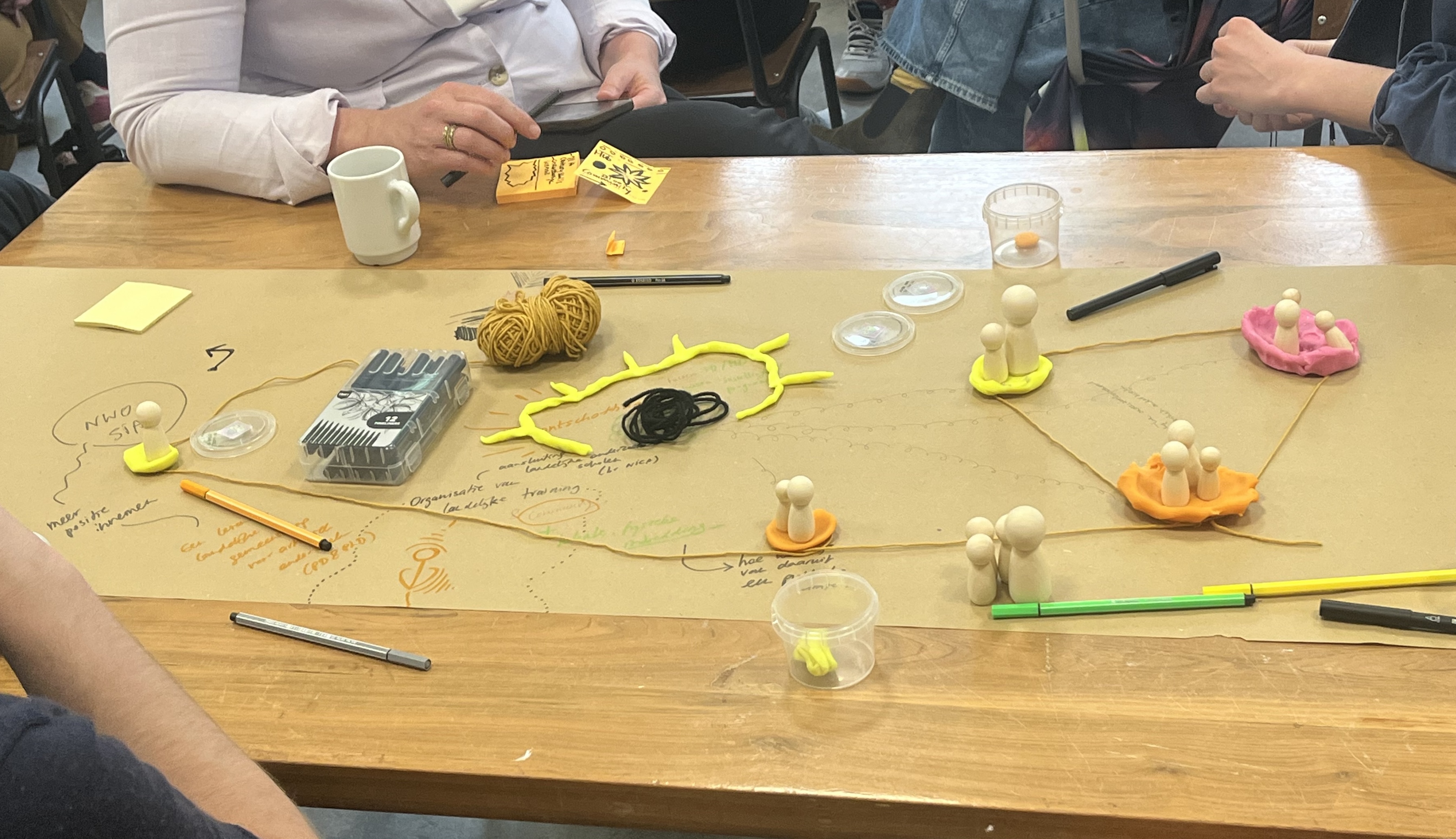
On the afternoon of Friday 8 May 2026, a mixed group of professors, research supervisors, coordinators, and programme leaders came together to map the landscape of artistic research and exchange ideas across the various initiatives and platforms for artistic research, third-cycle (arts) education, and the PD Arts + Creative.
The working session (organised by platform kunst ≈ onderzoek and ARIAS) grew out of a shared desire to develop a joint approach to the challenges and ambitions that exist for the field as a whole, at a national level. We did this by collectively thinking about what artistic research in the Netherlands might look like in 2034, and designing a future scenario for it.
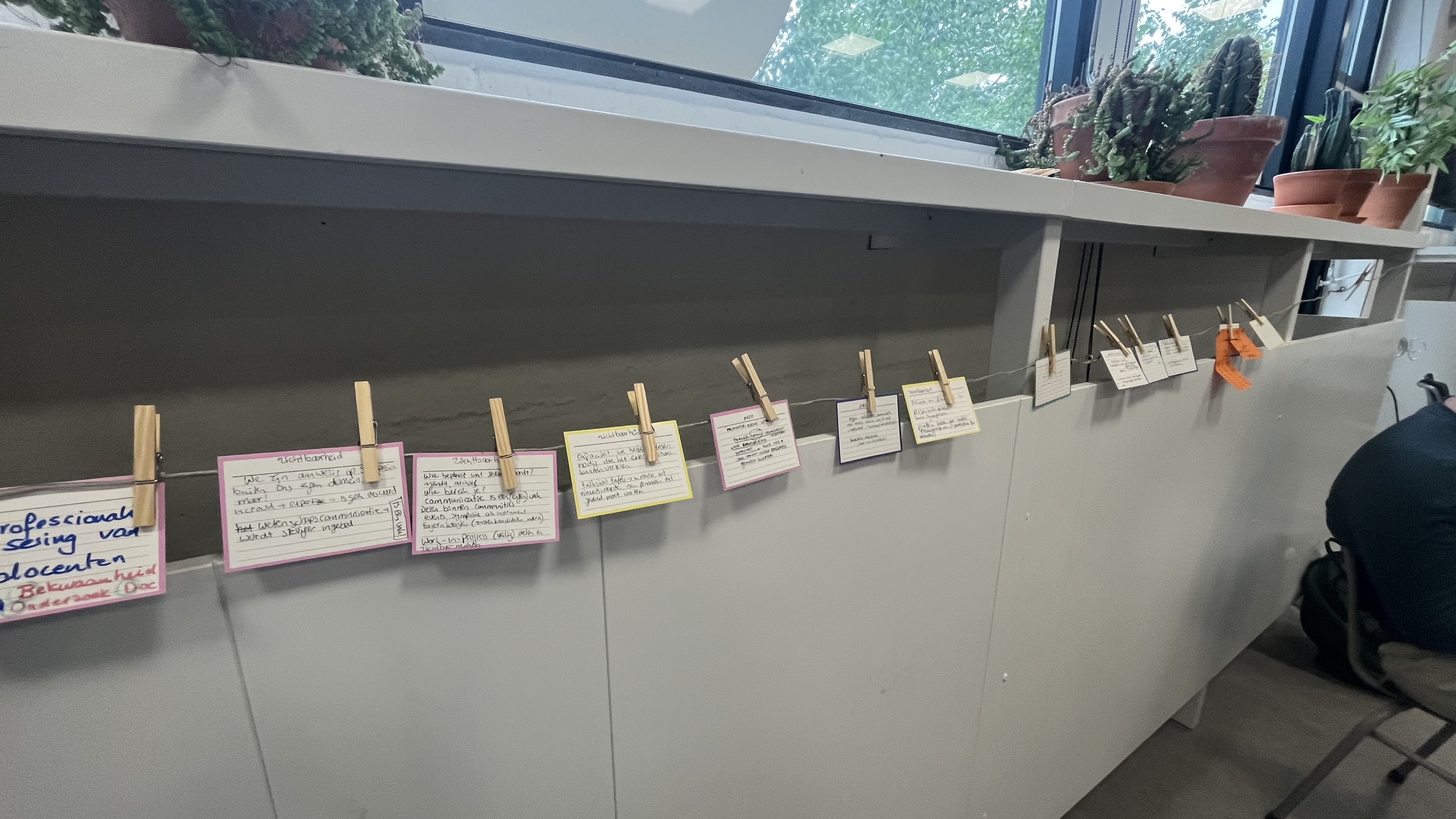
We then worked backwards to determine what would be needed to make this happen; who would play which role in that process, and how everyone could contribute: tomorrow, in one year, three years, and eight years. The afternoon concluded with a washing line full of follow-up steps and milestones through which we can pool our strengths and strengthen collaboration.
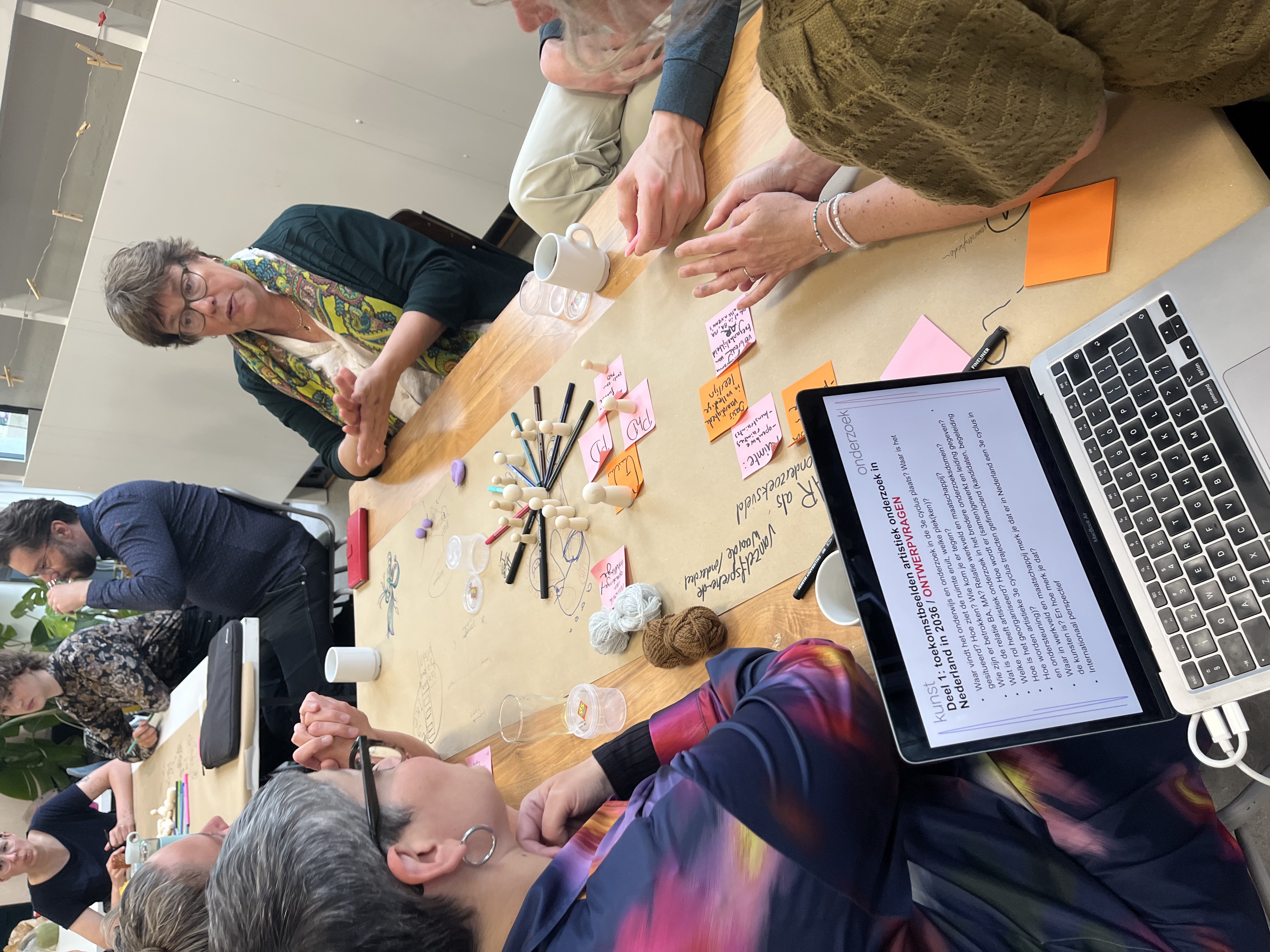
Some promising outcomes and perspectives that came out of this exercise included:
Programme / Curriculum
- A continuous curriculum in artistic research, starting from the BA and possibly combined with university/higher vocational education (in cross-disciplinary/transdisciplinary tracks).
- A professionalisation programme for teachers (and directors) in managing, conducting, and teaching artistic research methods (including Research Competence for Teachers and Directors).
Visibility
- A national structure for artistic research (e.g. a Graduate School).
- Alongside the annual PD Arts + Creative conference (ongoing), which also serves a strategic purpose, a biannual artistic research conference for exchange among doctoral candidates from various programmes, for policymakers, supervisors, and coordinators (e.g. the further development of DIS_SEMINAR, 2028).
- Better mutual coordination and sharing of presentation and publication opportunities.
- Increasing the visibility of collaboration with cultural institutions and the professional field; presence in the public sphere.
Supervision and Quality
- An inventory of criteria, good practices, supervision. Who is based where with what expertise, making it easier to find one another.
- A dedicated national validation committee for artistic research, comprising people with knowledge from the professional field and artistic research. As a field, we can then vouch for it ourselves. This also ensures quality assurance for the deployment of artistic research in other domains.
- Expansion of the pool of supervisors and the right to confer doctorates: drawing on the practical experience and knowledge of people who have completed a PD/PhD in the arts to support the next generations of doctoral candidates. There is of course a difference between sitting on a supervisory team and actually holding the right to confer doctorates. But almost all current professors have completed PhDs at universities. So in about 3-4 years a shift is coming, as the first cohorts complete their programmes and their knowledge can be put to use in quality supervision.
- Possibility of becoming a professor with a PD title, first PD professor at an arts university.
- Flexible capacity: regarding external co-supervision hours (pool of closed grants) or experts from the field (for a fee).
- Fair Practice in Supervision: this concerns quality, social skills, expertise, guidance, wellbeing, fair working practices, and responsibility and care towards candidates. A code of conduct is part of this: not just fair pay, fair practice also covers diversity and inclusion, trust, sustainability, and transparency.
This gathering was a follow-up to an initial online meeting in July 2025 on this theme, initiated by ARIAS. The starting point was the input from the questionnaire distributed among initiatives and platforms for artistic research and third-cycle (arts) education.